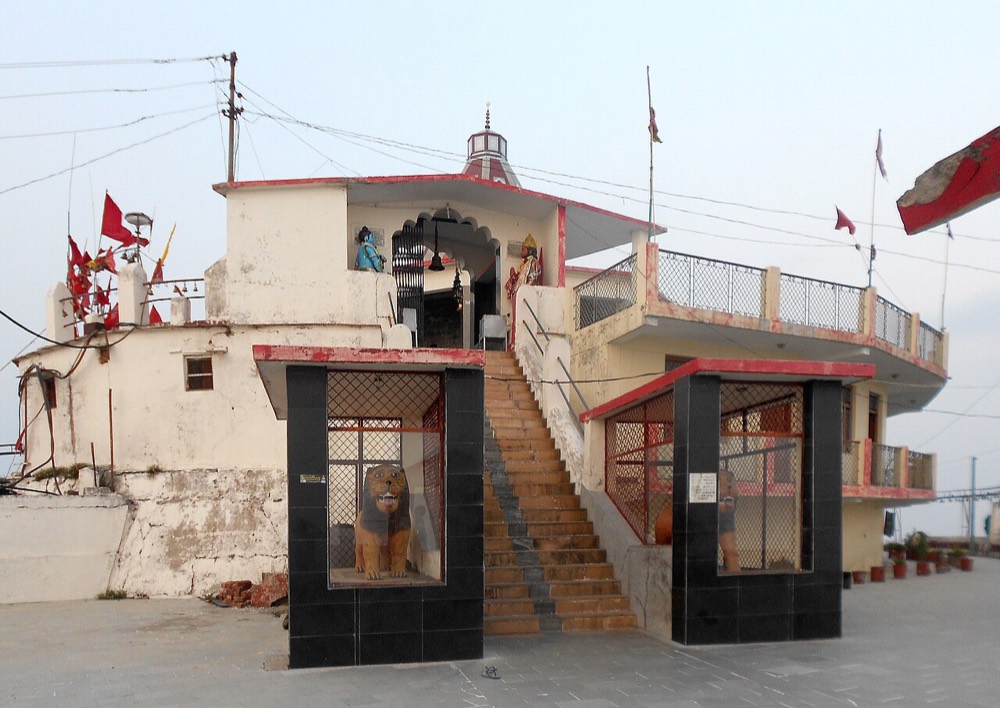
Chandrabadani Devi — counted among the network of Shakti Peeths across the subcontinent.
The Shakti Peeths are among the most evocative ideas in Hindu sacred geography: a web of shrines, scattered across the Indian subcontinent, each marking a place where a part of the Goddess's body is said to have fallen to earth. Together they turn the whole land into a single sacred body of the Divine Mother.
The story behind the peeths
The peeths arise from the cycle of Sati and Shiva. When Sati gave up her body at her father Daksha's sacrifice, a grief-maddened Shiva carried her remains across the cosmos in the wild dance of Tandava, threatening creation itself. To release him, Vishnu sent forth his Sudarshan Chakra, which cut Sati's body into many pieces. Wherever a part fell, that place became a Shakti Peeth — charged forever with her presence. You can read the full account on our Legend page.
Why "51"?
The count varies by tradition. Many texts and pilgrims speak of 51 Shakti Peeths, often linked to the 51 letters of the Sanskrit alphabet; other traditions count 52, 64 or even 108. Each peeth is traditionally honoured as a pairing of a form of the Devi with her guardian Bhairava, and each is believed to grant siddhi — spiritual fulfilment — to the sincere devotee.
Some of the great peeths
The most celebrated Shakti Peeths stretch from the Himalaya to the far corners of the subcontinent — among them Kamakhya in Assam, Kalighat in Kolkata, Vishalakshi at Varanasi, and shrines reaching into present-day Pakistan, Bangladesh, Nepal and Sri Lanka. Across this vast spread, each shrine guards the memory of a single part of the Goddess.
Where Chandrabadani belongs
In Garhwal, Chandrabadani is revered as the place where the torso (kandh) of Sati came to rest atop Chandrakoot mountain — which is how it earns its title of Siddh Peeth. Uniquely, the Goddess here is worshipped not as an image but as a Shri Yantra, the sacred diagram of interlocking triangles. It stands alongside Surkanda Devi and Kunjapuri as one of the three Siddh Peeths of Garhwal.